

Twin Screw Extrusion Machine for Telecoms Cable Sheathing: How High-Speed Compounding Serves Network Infrastructure
Fiber optic networks depend on more than the glass fibers carrying data. Their protective jackets and microduct walls must withstand sunlight, temperature changes, installation stress, and long periods outdoors without losing the flexibility required for routing and maintenance.
A twin screw extrusion machine supports the preparation of polymer compounds used in these applications by blending base resins with stabilizers, pigments, and other additives. The quality of this compounding stage affects how consistently the finished material performs, particularly when HDPE, MDPE, or UV-stabilized formulations are specified for telecommunications infrastructure.
Formulating HDPE and MDPE for Cable Protection
HDPE and MDPE serve different needs in cable and microduct applications. High-density polyethylene generally offers relatively high stiffness and strength, making it useful where dimensional stability and resistance to external forces matter. Medium-density polyethylene can provide a useful balance of toughness and flexibility, depending on the grade and formulation. The appropriate material depends on the cable construction, installation method, expected environmental exposure, and relevant product specifications rather than resin density alone.
Compounding brings the resin together with additives that influence processing and service performance. Carbon black or other approved UV-protection systems may be used in outdoor formulations, while antioxidants help limit degradation during processing and prolonged exposure to heat. Pigments and processing aids also need to be compatible with the polymer and the intended application. Incorrect additive levels or uneven dispersion can create variations in color, mechanical properties, or weathering performance across a production batch.
The screw configuration influences how effectively ingredients disperse throughout the melt. A suitable twin screw extruder can provide controlled feeding, mixing, and conveying, helping processors manage formulations that contain multiple ingredients. Screw design, rotational speed, temperature profile, and throughput must be considered together: excessive shear or heat may damage sensitive additives or degrade the polymer, while insufficient mixing can leave localized concentrations of stabilizers or pigments. Consistent feeding and controlled residence time help maintain compound uniformity at production scale.
UV Resistance and Flexibility in Outdoor Networks
Sunlight exposure can gradually change the properties of polymer jackets and microducts. Ultraviolet radiation initiates degradation reactions in susceptible materials, potentially causing discoloration, surface cracking, reduced elongation, or loss of impact performance. UV-stabilized formulations are designed to slow these changes, but their effectiveness depends on the stabilizer system, concentration, dispersion, base resin, and actual exposure conditions. A compound intended for buried ducting may not meet the requirements of a product installed above ground in direct sunlight.
Carbon black is commonly used in many outdoor polyethylene products because it can provide effective UV protection when properly selected and dispersed. However, its performance is not determined by concentration alone. Particle characteristics, dispersion quality, and compatibility with the rest of the formulation influence the final result. Other stabilizer systems may be specified where product color or application requirements restrict the use of carbon black. Accelerated weathering tests can help compare formulations, although field exposure and service conditions remain important when interpreting test results.
Flexibility must also be preserved throughout the expected operating range. Microducts may need to bend around installation routes without kinking, while cable jackets must tolerate handling, pulling, and movement without cracking. A compound that becomes too stiff may complicate installation; one with insufficient stiffness may deform under external pressure. Material testing should examine tensile behavior, elongation, impact resistance, and relevant low-temperature performance.
Compounding Control and Production Consistency
Stable compounding begins with accurate ingredient preparation. Variations in resin grade, moisture contamination, additive dosing, or feed rate can alter melt behavior and finished material properties. Gravimetric feeding, suitable material handling, and routine checks of incoming ingredients help reduce these variations. Production records are also valuable because they allow a processor to trace changes in quality back to specific raw-material batches or operating conditions.
Temperature management is another critical factor. Polyethylene must reach a suitable processing state for mixing and downstream extrusion, yet excessive thermal exposure can promote oxidation or molecular degradation. Screw speed, barrel temperature, feed rate, and residence time affect the balance between mixing effectiveness and heat generation. Processors should monitor these variables alongside melt pressure and output stability, then validate the resulting compound using appropriate laboratory tests rather than relying on machine settings as proof of material quality.
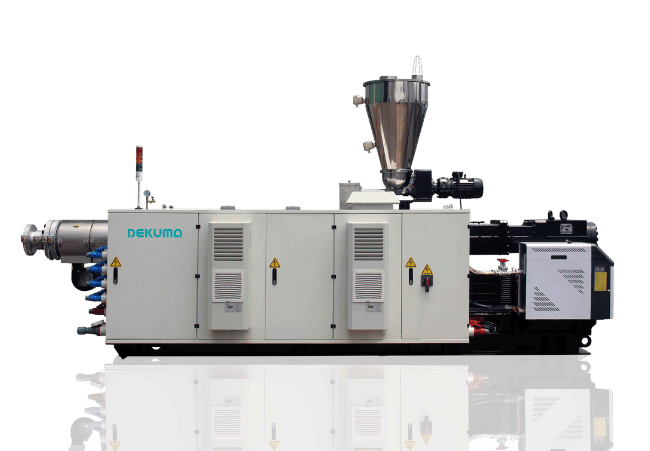
DEKUMA offers the DKM-EII Twin-Screw Pipe Extruder, featuring an AC/DC motor, an Italian-imported gearbox, a raw-material hopper with blender and twin-screw feeding, and a control system with real-time data logging. Its wear-resistant alloy-steel barrel receives nitrogen treatment, while the twin-screw assembly is designed for high-output processing of CPVC and UPVC formulations. These stated capabilities relate to pipe extrusion and specified PVC-based materials; suitability for HDPE, MDPE, or UV-stabilized telecommunications compounds must be confirmed against the required material formulation and production configuration rather than assumed from the machine description.
Conclusion
Telecommunications cable sheathing depends on the relationship between polymer selection, additive distribution, and process stability. HDPE and MDPE formulations must provide the appropriate balance of strength and flexibility, while UV-stabilization systems need to retain effectiveness throughout outdoor service. A twin screw extruder can support controlled compounding when its configuration matches the formulation and operating window, but weathering, mechanical, and dimensional tests remain necessary to verify the finished material.
With its DKM-EII equipment and broader extrusion expertise, DEKUMA provides a concrete example of industrial process-control features; any application to telecoms sheathing still requires technical confirmation for the target polymer, compound, and production requirements.